Quality of Service (QoS) Enterprise Networking Guide
09 Jul, 2026
Quality of service (QoS) in enterprise networks
When enterprise networks are at peak load, they need to prioritise some traffic over others. Quality of Service is the system that decides what to prioritise, allocating bandwidth to mission-critical applications while queuing other requests.
QoS gives an enterprise network the discipline to perform under pressure, even when capacity is tight.
What is quality of service in networking?
Quality of Service (QoS) is a set of network technologies and policies that prioritise traffic highly sensitivity to lag. This includes activities such as VoIP, video streaming, and real-time monitoring, where even minor delays can cause major disruptions.
QoS is inherently flexible and adapts to changing conditions:
- Runs on routers, switches, and SD-WAN controllers as packets pass through.
- Applies pre-set rules when capacity is stretched, moving the most urgent packets first.
- Adapts to changing business needs, since policies can be reconfigured at any time.
Why is QoS important for enterprises?
When networks experience congestion, some traffic will move more slowly than normal. This can lead to packet loss and unpredictable latency, which seriously degrades the performance of certain applications.
QoS reduces the impact, leading to:
- Reliable performance for business-critical applications
- Predictable user experience, even during peak network load
- Consistent uptime across sites and providers
- Efficient use of available bandwidth
- Scalable systems capable of handling network traffic variations
Venn's global enhanced internet service applies these standards to every site, so QoS policies behave consistently for enterprises operating across multiple regions.
What are the main QoS mechanisms?
Most enterprise networks operate on the DiffServ model, where traffic is classified into service classes and marked with DSCP (Differentiated Services Code Point) values for consistent treatment across routers and switches.
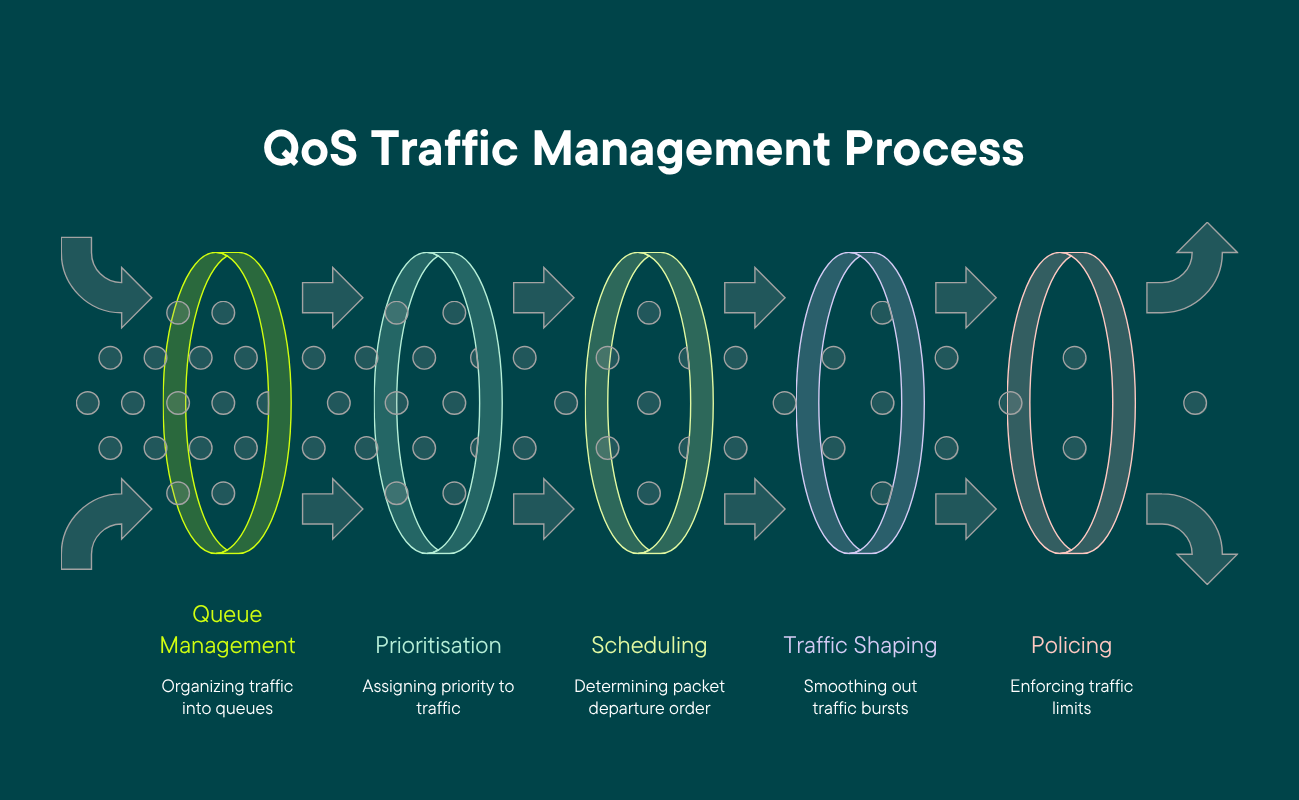
The key mechanisms of all QoS systems are queue management, prioritisation and scheduling, traffic shaping, and policing and rate limiting.
How is quality of service measured?
QoS metrics focus on the real-world impact of bandwidth restrictions. For example, Venn's Network Visibility as a Service platform tracks these metrics in real time across every site and transport, so performance dips are visible before they affect business operations.
Bandwidth utilisation
Utilisation shows the percentage of bandwidth being occupied at any one time. QoS metrics show utilisation statistics broken down by application class, allowing network managers to identify any issues in traffic misclassification.
Latency
Latency is the time it takes for packets to move from source to destination, measured in milliseconds. Real-time applications such as voice and video typically require latency under 30ms. Most enterprise applications function reliably with latency under 100ms.
Jitter
Latency refers to average speed; jitter describes variations in speed. High levels of jitter can impact application performance, even if the overall latency statistics seem healthy. The threshold for acceptable jitter is typically a 30ms variation.
Packet loss
VoIP and video conferencing are extremely sensitive to packet loss. Even a 1% drop rate is audible on a call and visible in a stream. QoS dashboards report packet loss in two ways: per-link, to show where packets are being dropped, and end-to-end, to show what users actually experience.
Availability and uptime
Networks experience a certain amount of downtime, which then impacts overall performance. Recurring uptime issues can point to a need for a hybrid network, with multiple transports providing more consistent connectivity.
How is QoS managed and monitored?
In a managed setup, performance is monitored continuously across every site and link. Policies are fine-tuned to respond to changing connectivity requirements.
This requires the right data visibility, as well as the right technical talent to implement solutions.
Venn delivers this through its Network Access Service Edge, a managed overlay that carries customer traffic over a private global backbone. Because policy is enforced at the overlay rather than the underlying link, QoS rules apply consistently whether a packet travels over fibre, cellular, or satellite.
- Real-time visibility: Latency, jitter, packet loss, and bandwidth are tracked per site and per transport through the Venn Portal and SIM Cloud dashboards.
- Policy enforcement across transports: A single QoS policy follows the traffic so the same prioritisation rules apply on every link.
- Proactive alerting: Performance thresholds trigger alerts before users notice degradation.
- SLA reporting: Performance data is rolled up against contracted service levels and ready for audit.
This is delivered as part of Venn's flexible network solutions, where multi-transport connectivity sits under a single performance contract backed by monitoring and support.
How to implement QoS for your network
The QoS implementation process has four stages: assess, design, deploy, monitor. The same four stages apply whether it's handled in-house or delivered through a managed connectivity partner.
- Assess: Analyse current performance and map the traffic profile at each site. Identify which applications have the lowest tolerance for latency.
- Design: Define service classes for traffic types. Set bandwidth allocations for those classes based on business requirements, and agree performance thresholds for critical services.
- Deploy: Test policies in staging, then apply across routers, switches and SD-WAN controllers.
- Monitor and tune: Continuously measure performance, with special focus on mission-critical services. Adjust policies when business needs evolve.
How does QoS operate across hybrid networks?
Hybrid networks combine multiple methods of connectivity, such as fibre, 5G and LEO satellite, and traffic is automatically routed to the best available connection.
QoS can break down here, as each transport has its own profile of capacity, latency, and jitter, which means they can’t be governed by a single policy.
SD-WAN bonding solves this problem by ensuring policy travels with the traffic, not the link. Traffic is split across transports at the customer edge, recombined at a peer on the provider's backbone, and treated as a single ordered flow throughout.
Encrypted traffic is another challenge for QoS, as protocols such as VPN, TLS and secured SCADA hide the payload from inspection. The move towards zero-trust architectures means that even more traffic is encrypted by default. The fix is to classify on source, destination, port, and DSCP markings applied at trusted endpoints before encryption, so QoS never depends on reading the packet contents.
Quality of service: Best practices
QoS depends on careful calibration based around organisational needs. Best practices ensure the best possible implementation:
- Prioritise by outcome. Map the critical business processes and build the QoS strategy around mission-critical connectivity requirements.
- Test before deployment. Thorough testing helps ensure a seamless transition to updated QoS policies.
- Monitor continuously. Regular monitoring ensures the QoS is matched to current requirements.
- Assign QoS classes according to expected performance. Link QoS policies to the expected service on each transport.
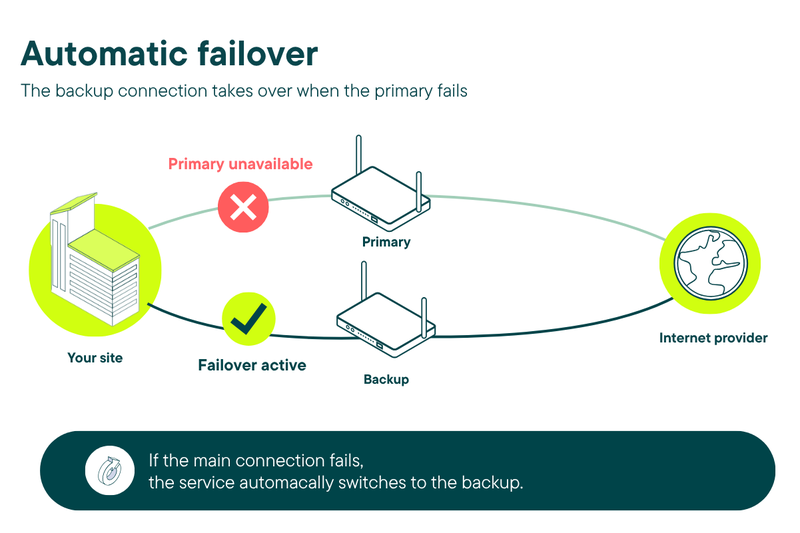
- Build failover into the policy. Ensure that QoS policies never encounter a single point of failure.
These best practices are also an evaluation criteria for a connectivity partner. The right partner should be able to deliver a robust, flexible QoS strategy that is tailored to your requirements.
Venn delivers QoS as part of its flexible network solutions, managing performance end-to-end across fibre, cellular, and satellite for enterprises that need consistent service everywhere. Get in touch to see how Venn can support your enterprise network.
Ready to improve your network performance? Venn Telecom’s team can help you implement QoS and more as part of our flexible network solutions.
QoS: Frequently Asked Questions
How does QoS work with SD-WAN?
SD-WAN classifies traffic at the edge and applies QoS policies before routing it across transports. This allows consistent QoS across different connection types, and makes it possible to classify encrypted packets.
Can QoS work across multiple connection types?
Yes. SD-WAN bonding allows QoS policies to follow the traffic across transports with different speed and latency profiles, such as fibre and satellite.
What is end-to-end QoS?
End-to-end QoS ensures consistent treatment from source to destination, with classification and policy enforcement at every hop the packet crosses.
How does QoS handle encrypted traffic?
By classifying on source, destination, port, and DSCP markings applied at trusted endpoints before encryption. Prioritisation then doesn’t require access to the packet payload.
What are the main QoS models?
DiffServ and IntServ are the two most common models, with variations in how they handle packet labelling and flow management. DiffServ is the most popular model on enterprise networks.
What is the difference between QoS and CoS?
CoS marks traffic at Layer 2 within a single network segment. QoS includes CoS but extends prioritisation end-to-end across the full route.
Real-world QoS in action
Quality of Service matters most where connectivity is constrained, as shown by these enterprise case studies:
DEME (Offshore maritime): DEME’s fleet of vessels operates across Starlink, 4G/5G, and VSAT backup. Venn manages QoS across all three, so vessel operations and crew communications stay prioritised over background traffic even when the primary link degrades.
Uniper (Remote energy and industrial sites): For Uniper, a hybrid Starlink + SD-WAN setup carries operational traffic across multiple connections. QoS holds critical operational data at the top of the queue while general site connectivity takes the remainder, with intelligent routing handling transport changes automatically.
Discover more

Ready to improve your network performance?
Venn Telecom’s team can help you implement QoS and more as part of our flexible network solutions.