Starlink vs fibre internet for businesses
22 Jun, 2026
Starlink vs fibre internet for businesses
- Starlink, powered by a constellation of low-earth orbit (LEO) satellites, provides mission-critical connectivity in the remotest locations, including on the open sea.
- Fibre internet needs physical cabling, making it less flexible, but offers unbeatable speeds and low latency.
Which service is best for your business? In this article, we will look at the pros and cons, so you can decide what’s most suited to your needs: Starlink, fibre internet, or a hybrid mix of both.
Starlink vs fibre: differences at a glance
Here is an at-a-glance guide to the key differences between Starlink and fibre internet.
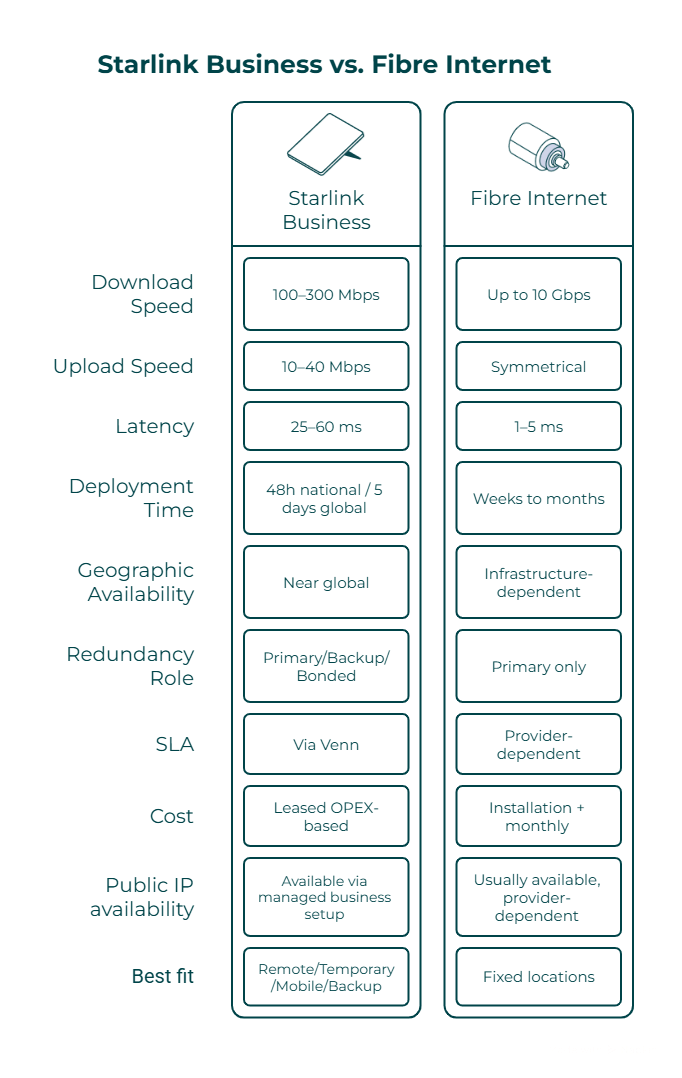
What do the differences between Starlink & fibre mean in practice?
Starlink and fibre internet are not like-for-like equivalents. They are two fundamentally different types of infrastructure, each with strengths and weaknesses: fibre is faster and has lower latency; Starlink wins on availability, deployment speed, and built-in failover.
The right choice depends on your specific business needs.
Speed & upload symmetry
Latency on fibre networks is 1-5ms, which makes it suitable for functions where low-lag connectivity is a mission-critical requirement, such as the operation of IoT devices.
Starlink’s LEO satellites have latency in the range of 25-60ms, substantially faster than geostationary orbit (GEO) satellite communication.
Deployment time
Starlink is already deployed in low-earth orbit. The only delay is in provisioning a Starlink dish, which typically takes between 48 hours (national) and 5 days (global).
Fibre installation can take longer depending on local infrastructure, with typical wait times of several weeks or months.
Geographic availability
Starlink is a truly global network, servicing 150 countries with thousands of satellites. Fibre internet is only available in locations with an existing fibre infrastructure.
In white zones, offshore environments, or regions where fixed-line installation is impractical, satellite is frequently the only viable option. For example, we built a bonded 4G and Starlink solution for Willemen Groep, a Belgian construction firm that regularly works in white zones without reliable mobile or fibre coverage.
Redundancy and failover
Fibre internet is vulnerable to physical failures, and a major outage can force entire regions offline. Starlink offers multiple layers of redundancy, so if one satellite fails, another satellite in the constellation can maintain the connection. In this way, Starlink can act as a failover layer alongside a primary fibre line.
What is Starlink internet?
Starlink is a network of low-earth orbit (LEO) satellites that operate at an altitude of 550km, which provides much lower latency than traditional communication satellites.
Starlink offers a residential service as well as Starlink Business, with the latter adding priority traffic, legal compliance, and management options designed for enterprise needs.
When is Starlink the better choice?
Starlink is a stronger option where fibre is unavailable, impractical to install, or too slow to deploy.
That includes remote sites with no fixed-line infrastructure, white zones, temporary or mobile operations, and locations where waiting weeks for a cable installation would delay critical work or expose the business to unnecessary risk.
In these cases, we package Starlink as an enterprise-ready service with managed hardware, deployment, and ongoing support.
What is fibre internet?
Fibre internet transmits data at near the speed of light through fixed, durable cables. It is the fastest form of internet currently available, offering huge speeds and the ability to handle large data transfers.
Fibre internet services are offered by multiple providers, which means a range of enterprise options suited to different business needs.
When is fibre internet the better choice?
Fibre is best when there is access to an existing network in your region. Fibre is also the right choice if your business needs require high speeds and low latency, or if you need a network that can handle high-volume data transfers.
Starlink vs fibre for enterprise use cases
Different industries have different requirements for internet connectivity. Here is how Starlink and fibre internet compare across different sectors.
Maritime and offshore connectivity
Fibre internet is not an option at sea, which is why our maritime connectivity work typically pairs Starlink with other satellite or 4G/5G links. Starlink is much faster than legacy maritime services such as VSAT, and for vessels operating closer to shore it often outperforms the 4G/5G fallbacks.
Construction and industrial sites
Fibre internet provides the low-latency connectivity that IoT-heavy operations often depend on, which is why most of our manufacturing and industrial deployments lead with fibre. If fibre is not available at the project site, or if the timeline means you can’t wait for a new fibre connection, then Starlink is a reliable alternative.
Remote and temporary sites
Starlink’s rapid deployment makes it a strong option for temporary sites, such as broadcasting and event, where a fibre-based installation takes too long.
In more remote sites, especially in difficult-to-access areas, fibre internet is simply unavailable. Starlink is not constrained by infrastructure and can provide connectivity in these regions.
Multi-site enterprise operations
Multi-site organisations typically implement a hybrid solution, with a slightly different configuration in each location. Central offices in urban centres favour a high-speed fibre connection, while remote fleets favor mobile solution like Starlink. This pattern is common in transport and logistics networks where the same operator may need stable HQ connectivity and roaming coverage across vehicles and yards.
Urban enterprise environments
In dense urban areas, high-quality fibre infrastructure is usually available and typically the right primary choice for those seeking low latency, symmetrical uploads, and consistent performance.
That said, even urban enterprises benefit from a wireless backup alongside their fixed line. A severed cable in a city centre can cause long-lasting outages that may impact business operations.
Should Starlink replace fibre or work alongside it?
One network is not enough. The best solution is a combination: fibre as the primary where available, and Starlink as a backup or as the primary in places where fibre can’t reach.
These can be bonded with Peplink SpeedFusion into a single managed connection with intelligent failover, so losing one link doesn’t mean losing the network. This approach gives you both speed and flexibility, with an extra layer of resilience.
This hybrid approach was taken by Uniper, a low-carbon energy company with complex connectivity needs. When they outgrew their existing MPLS connections, they realised that they needed a new approach to connectivity with failovers to guarantee uptime. Uniper, with help from our team, transitioned to a combination of Starlink and other connectivity methods, ensuring they stay online even when one method fails.
FAQs
Is Starlink faster than fibre?
Fibre is substantially faster than Starlink and offers symmetrical upload/download speeds. However, Starlink’s typical speeds of 100-300Mbps make it suitable for most business purposes.
Is Starlink better than fibre for business?
Starlink is a better option when there is limited access to a fibre network or an urgent need to get connected. When otherwise available, fibre offers faster results for business.
Can Starlink replace fibre for enterprise use?
Starlink is suitable for enterprise use, thanks to download speeds of 100-300Mbps. However, most businesses would use fibre as their primary connection if available.
Starlink is usually deployed in one of three ways: as a primary WAN link where sites don’t have other connectivity choices, as a failover path, or a bonded augmentation layer aggregated via SD-WAN.
How does Starlink compare to DSL?
Starlink outperforms DSL on speed and consistency. DSL relies on copper telephone lines and degrades with distance from the exchange. Starlink is distance-independent and delivers reliable speeds in most locations.
How does Starlink compare to broadband?
Compared to standard fixed broadband such as ADSL or VDSL, Starlink typically delivers higher and more consistent speeds, particularly in rural or underserved areas where fixed-line infrastructure is limited.
Can Starlink work as a backup for fibre?
Yes, and it is one of its strongest enterprise use cases. Peplink SpeedFusion allows you to bond both into a single managed connection, offering a best-of-both-worlds solution with maximum durability.
Discover more


Business Starlink vs. Residential Starlink
Bringing high-speed broadband to remote locations worldwide, Starlink is a connectivity game-changer. It offers both a residential and Business/Enteprise internet service, so how do they differ, and is Starlink Business worth it?
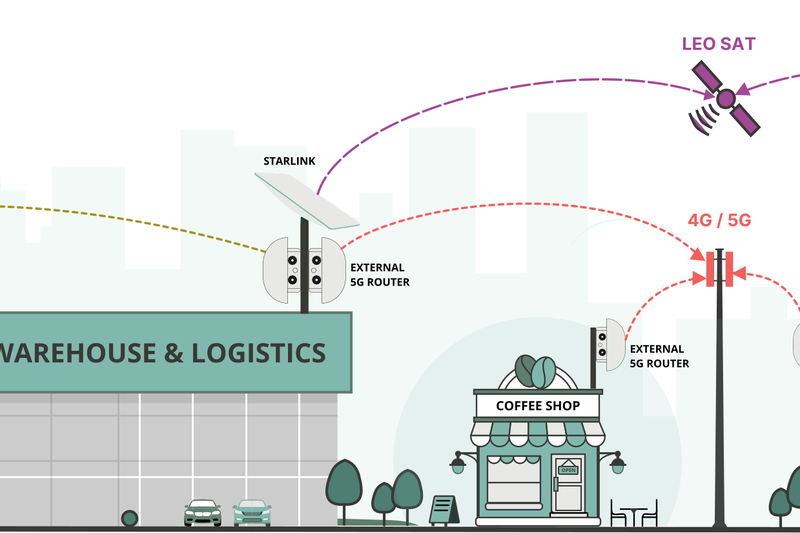
Connectivity Problems? Combined Starlink + 5G Service Changes Everything
Reliable internet is crucial when dealing with real-time data – and we're all using real-time data now, as our CTO Martin Langmaid explains. So what do businesses do when their connectivity options have traditionally been limited?